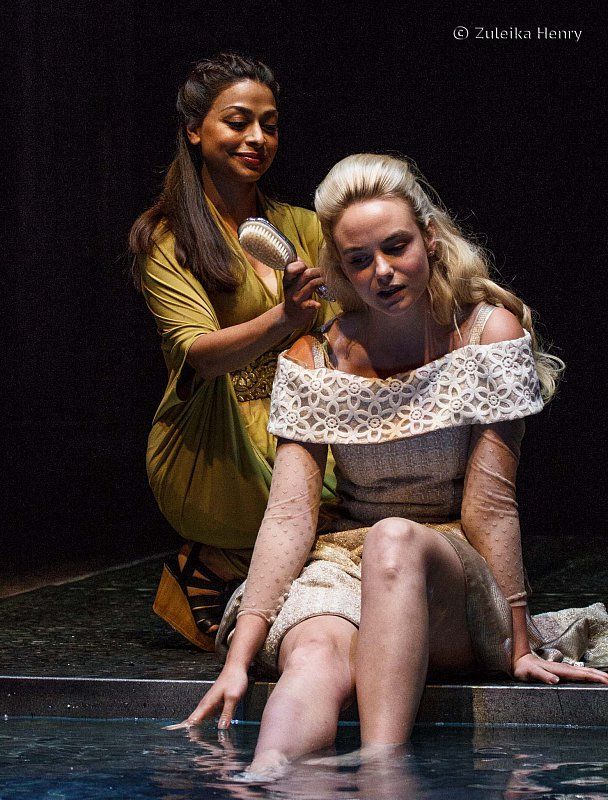
- Revise your key quotes on Quizlet.
- Learn the stuff on this Keats Knowledge Organiser.
- Brainstorm revision topics for each text (see my suggestions on the images below).
- For each revision topic, create notes pages or revision cards, with key quotations.
- Test your knowledge of aspects of tragedy by randomly selecting one from the star sheet (use this!), putting it in the middle of a blank piece of paper and brainstorming how that idea relates to Keats and Othello (with quotations). Start by doing it from memory, then add more ideas using your texts/notes.
- There's a great podcast on Othello which you can find here. It's also available to download on iTunes (search 'Lend Me Your Ears'). It starts off with a gentle intro and plot summary (the first 12 minutes), but gets into some interesting discussions around key themes: race, identity, outsiders, storytelling etc. I'll try to remind you about this again next year.
- There's another Othello podcast (this time from acclaimed author Emma Smith at the University of Oxford) here.
Tuesday, 20 July 2021
Y12: End of Year Tasks and Revision Resources
Thursday, 4 March 2021
Y12: Lockdown Lit 8.2 | To die upon a kiss
Here it is. We’ve reached the end
of Othello.
I’ve kept it fairly simple today
as I know a few of you need to get caught up so that we’re ready for next week.
So, it’s just reading, three questions to get your reactions to the ending,
annotations and quick exit quiz. This should be do-able inside an hour.
You’ll find all the work on this powerpoint:
See you next week!
Mr M
Monday, 1 March 2021
Y12: Lockdown Lit 8.1 | Journey's end
Last time, we paused at
the death of Emilia. Today, we’ll look at our penultimate chunk of the text,
leaving the final lines for Friday.
Here’s a breakdown of what our
work today involves:
1) Revision/memorisation of La
Belle Dame sans Merci (10 mins)
2) Watching the final 20 minutes
of the National Theatre Othello (if you haven’t already) (20 mins)
3) Annotating an extract (10
mins)
4) Reading and annotating (20
mins)
5) Writing an introductory
paragraph on the extract (10 minutes to prep, 10 minutes to write)
6) A second annotation video (20
minutes)
7) Exit quiz (5 mins)
This should all be achievable
within the two lessons.
You’ll find all the work on this powerpoint:
Let me know if you need anything.
Mr M
Thursday, 25 February 2021
Y12: Lockdown Lit 7.2 | Emilia speaks out
Last time, we reached the
dramatic death of Desdemona. Today, our attention turns to Emilia. The video is
a bit long today as I wanted us to crack through a lengthy section to put us in
position to focus solely on the tragic hero next week. So it’s just recap, reading
and annotations, exit quiz.
You’ll find all the work on this powerpoint:
Any always, give me a shout if
you need any help.
Mr M
Tuesday, 23 February 2021
Y12: Lockdown Lit Week 7 | Othello: The Murder
We’ve made it to the final, climactic scene of Othello!
We’ll probably get to the end of the play just in time for our return to school. At that point, we’ll do an essay or two and then get cracking on some more Keats. Despite everything, we're pretty much where I was with my Y12s last year before any time was lost to lockdowns. So we're doing well and haven't really lost any time.
You’ll find a full two hours of work on this powerpoint:
As always, let me know if you have any
problems or need any help.
Mr M
Monday, 8 February 2021
Y12: Lockdown Lit Week 6 | The Ambush
Hello Y12,
Well, we’re suddenly into the final
act and the penultimate scene! Today’s scene is all action, chaos and
confusion. We’ll see Iago scrambling to keep everything together.
The work should be do-able within
the two hours of lesson time today. Here’s a rough idea of what you have to do
to help you to divide the work into two hours. You might be able to plan your
paragraph at the end of the first lesson:
First lesson:
Keats recap (10-15 mins)
Watch the scene (5 mins)
Read the scene (15 mins)
Watch video/annotate the first
part of the scene (20 mins)
Second lesson:
Plan paragraph (5 mins)
Write paragraph (15 mins)
Watch video/annotate the rest of
the scene (30 mins)
Exit quiz (10 mins)
You’ll find all the work on this powerpoint:
Let me know if you have any problems or need any help.
Mr M
Monday, 1 February 2021
Y12: Lockdown Lit Week 5 | The Willow Scene
Today, we’re going to watch,
read, annotate and interpret the ‘Willow scene’. If it comes to a question
about the women in the play or a Desdemona question, this is the key scene.
Then later in the week, we’ll focus our ideas on critical perspectives and write
a paragraph.
You’ll find all the work on this powerpoint (click to download or view below):
Let me know if you have any problems or need any help.
Mr M
Friday, 29 January 2021
Y12: Lockdown Lit 4.2 | Some eternal villain - 4.2 pt. 2
We’re keeping it simple today. I want to buzz us to the end of Act 4 Scene 2. The rest of the scene is fairly straightforward and I want us to be ready to start the next scene (which is an important one) next week.
You’ll find all the work on the powerpoint below. Just three things to do today:
- a quick recap
- reading and annotating
- an exit quiz
The video will give you some key facts for the exit quiz, so pay attention! And apologies for the dodgy edit and abrupt ending...
Let me know if you have any
problems or need any help.
Mr M
Tuesday, 26 January 2021
Y12: Lockdown Lit - Week 4 | Interrogation (Act 4 Scene 2)
Today, we’ll get started on Act 4 Scene 2 of Othello.
You’ll find all the work on the powerpoint below. There’s a trickier quiz to do, some reading and
annotation, a bit of criticism to read and few questions to answer. There’s an
extension task to do if you get through it all.
Please share your question doc on Google Classroom later on.
We’ll meet up to talk through the questions at 2.45.
Let me know if you have any
problems or need any help.
Mr M
Friday, 22 January 2021
Y12: Lockdown Lit - Week 3 | Lodovico arrives (4.1)
Today, we’ll finish off Act 4
Scene 1 of Othello. More absolute scenes in this bit!
Click here to go to today's recorded lesson.
Don't forget to speed me up. It's less painful that way!
You’ll find all the lesson resources on the powerpoint below or on Google Classroom. There’s a quiz to do, some reading and annotation, and a paragraph to write.
Please upload your paragraphs on
Google Classroom by Monday.
Let me know if you have any problems or need any help.
Mr M
Monday, 18 January 2021
Y12: Lockdown Lit 3.1 | Othello retires
We’ll be starting today’s work with a Google Meet at the normal lesson start time (11.25am). In this time, we’ll go over some questions from last time. Bear with me, it’s my first attempt at a Google Meet and I’ve tried to set it up through a ‘Question’ task on Classroom.
I’ll talk you through today’s
work in the meeting too. I’ve also got a few reminders for you.
Today’s extract and video is
a longer one. We’ll do the last little section of the scene on Friday.
Below, you’ll find the powerpoint for today’s lesson. It’ll be on GC too.
Mr M
Thursday, 14 January 2021
Y12: Lockdown Lit 2.2 | Othello's trance (4.1)
Hi folks,
I've changed my mind about the live debrief today. My video is too long and it'll be too rushed.
Instead, I'd like you to complete the work on the powerpoint below (download here). You may have done the first couple of
tasks already. We’ll do our live debrief at the start of next lesson before we
move on.
Let me know if you need any help,
Mr M
Tuesday, 12 January 2021
Y12: Lockdown Lit 2.1 | Understanding poetic metre
Today, I’d like you to develop your understanding of the poet’s art. We’ll learn more about poetic metre, poetic forms, rhyme schemes and scansion. This will be useful knowledge for studying both Keats and Shakespeare.
There’s enough work here for two lessons. There will be a quiz and a choice of writing challenges at the end.
Here goes:
1) First, take a look at these poetic feet (rhythmic patterns that repeat):
2) And now have a look at these meters:
By combining these rhythmic patterns and line lengths, you get your metre. For instance:
Iambic pentameter: . / . / . / . / . /
Anapaestic hexameter: . . / . . / . . / . . / . . / . . /
The key feature is the number of stresses. Penta means five. All lines in iambic pentameter must have 5 stresses, but they don’t all have 10 syllables. 11 syllable lines are common. Consider the most famous line in iambic pentameter:
To be, or not to be, that is the question. (11 syllables!)
The resources below should explain this.
3) Watch this video about scansion.
4) And this video about ‘why Shakespeare loved iambic pentameter’.
5) This clip explains some variations within iambic pentameter.
6) Now, take a look at this powerpoint about iambic pentameter and how it works in a sonnet:
7) And take a look at this powerpoint about different types of rhyme and line endings:
Now, our poet, Keats, wrote a handful of truly great sonnets. Check out two of my favourites below. The first is a Shakespearean sonnet and the second is a Petrarchan sonnet:
I think Chapman’s Homer is my favourite sonnet, even though it has a historical inaccuracy in it.
8) Test your understanding with this quiz.
9) Finally, I’m going to challenge you to write some verse in the first of what I’m going to call METRICAL CHALLENGES.
This is something I tried with Y7 (!) last year during lockdown and they were amazing at it. Look! Surely, Y12 Lit students can do better?
Below, you’ll find a series of challenges which increase in difficulty. You need to choose one, complete it, and then send me your work in an email. Capisce?
Challenge Level 1 – Rhyming couplets:
Challenge Level 2 – Quatrains:
Challenge Level 3 - Ballad opening:
Read the first three stanzas of these ballads:
Miss Gee – W.H Auden
Death in Leamington – John Betjeman
The Rime of the Ancient Mariner – Samuel Taylor Coleridge
Challenge Level 4 – Shakespearean Sonnet:
Challenge Level 5 – Petrarchan Sonnet:
I look forward to seeing what you come up with!
That’s all for today. On Friday, we’ll resume our study of Othello, picking up at the start of Act 4.
Enjoy your week and stay safe,
Mr M